
Drive down any street in Olympia or Lacey in February and look at the north-facing roof slopes. Most of them are green. Moss isn't a sign of a bad roof — it's a sign of a roof in Western Washington. Forty-plus inches of rain, months of low sun, and fir needles collecting in every valley make it close to unavoidable. What matters is what you do about it.
Here's why it's worth doing something. Moss is a sponge. It sits on the shingles and holds water against them for weeks at a time, which is exactly what asphalt shingles are designed to shed. As it grows, it works under the shingle edges and lifts them, and lifted shingles let wind-driven rain get underneath. A roof that should last twenty-five years can be done in fifteen if the moss is left alone.
The first thing most people reach for is a pressure washer, and it's the one thing we'd ask you not to do. Composition shingles are coated in mineral granules, and those granules are the roof's UV protection. A pressure washer strips them — you can see it in the gutters afterward, a grey sludge of what used to be your roof. The moss comes off, and a few years of shingle life go with it.
What we do instead is slower and gentler. The moss is loosened by hand with a soft brush or scraper, working down-slope so nothing lifts, and the loose material is blown off with a backpack blower. The needles and debris in the valleys and behind the chimney come out at the same time. On a typical Olympia ranch house it's a half-day job, and the shingles don't lose anything but the moss.
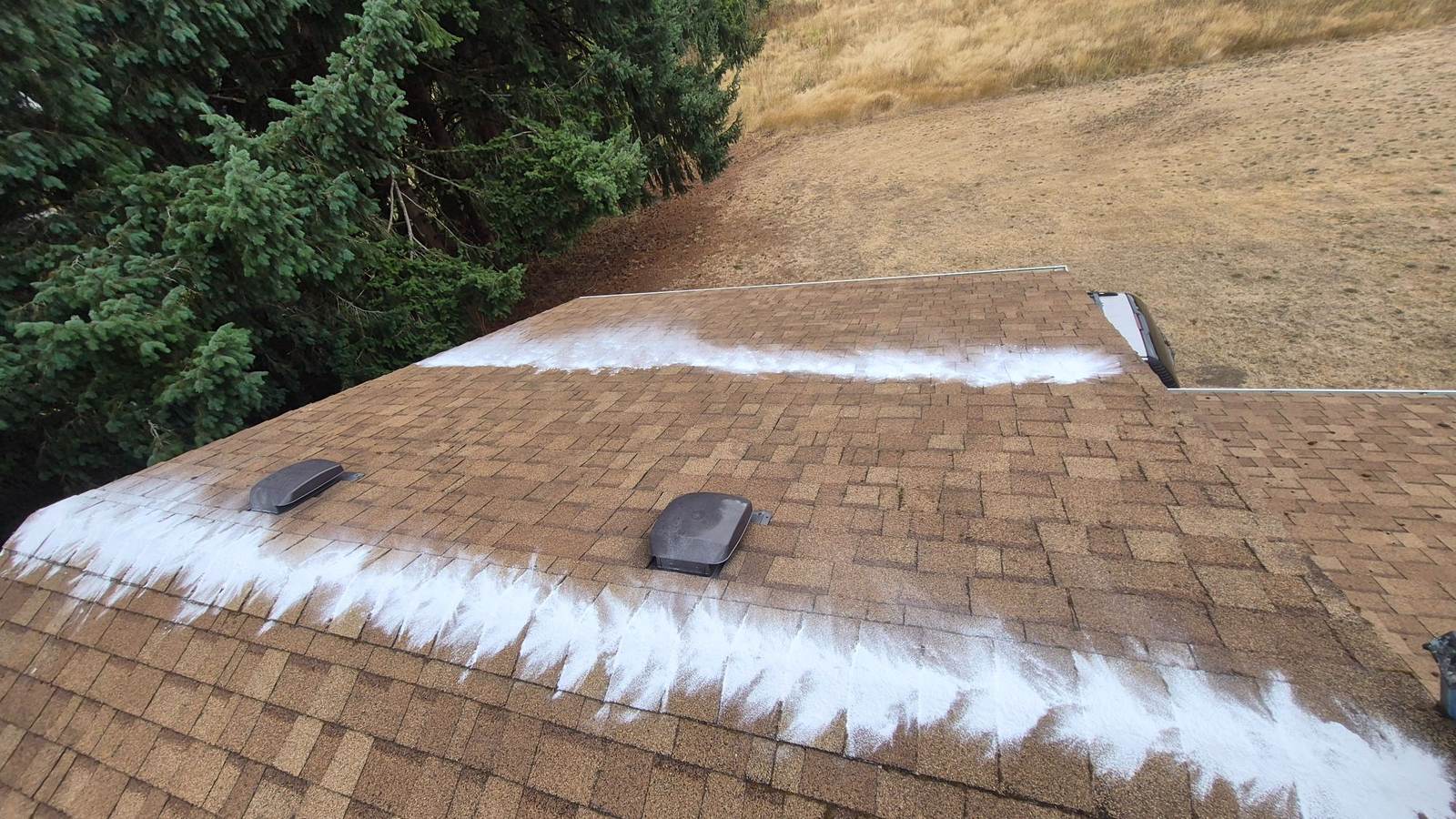
Cleaning alone doesn't keep it off, though. Moss regrows from spores and from the tiny fragments that are always left behind, so the second half of the job is treatment. Once the roof is clear we apply a moss killer along the ridges and across the affected slopes — you'll see it as a pale band along the top of the roof for a while. Rain carries it down the slope over the following weeks and it keeps regrowth down through the wet season. Zinc strips near the ridge do a similar thing over a longer timescale, and we can add them if you want a more permanent measure.
While we're up there, the gutters get done. It makes no sense to clear a roof and leave the gutters packed — the moss and needles we've just blown off have to go somewhere, and the gutters were probably full already. We scoop them, flush them, and run water down each downspout to make sure it actually drains. If a downspout is blocked, the water goes over the edge and straight down the siding into the foundation, which is a far more expensive problem than moss.
How often? For a roof under trees, once a year — ideally in late summer or early fall, so the roof and gutters go into the rainy season clean. Roofs in the open can go two or three years between cleanings once they've been treated. If you can see moss from the driveway, it's time.
One honest note: if the shingles are already brittle, curling, or missing granules across large areas, cleaning won't save them, and we'll tell you that rather than take the job. But most roofs we see are in decent shape under the moss, and clearing and treating them is one of the cheapest ways there is to add years to a roof.
Want us to take a look? Call Goodfellas Landscape at (360) 402-9183 for a free roof and gutter estimate anywhere in Olympia, Lacey, Tumwater, Tacoma, Puyallup or Gig Harbor.