
Almost every property we work on around Olympia has a wet spot. A corner of the lawn that squelches, a side yard that turns to mud, a low patch near the fence where the grass gives up and moss takes over. People try to fix it with more grass seed, then with more topsoil. Neither works, because the problem is underneath.
The ground here is glacial till in a lot of places — a hard, compacted layer not far under the topsoil that water can't get through. Rain soaks into the top few inches and then has nowhere to go. Add a slope that sends the neighbor's runoff onto your lot, or a downspout that dumps straight onto the ground next to the house, and you've got standing water for six months of the year.
A French drain is the standard fix, and it's simpler than it sounds. It's a trench, cut on a slight fall toward somewhere the water can go, with a perforated pipe in the bottom and drain rock around and over it. Water in the soil finds the rock, drops into the pipe, and runs off downhill instead of sitting in the lawn. The trench is topped with rock, or with soil and turf if you'd rather not see it.
The detail that separates a drain that works from one that doesn't is where the water ends up. A drain has to daylight somewhere — a lower part of the yard, a ditch, a dry well, a storm connection where that's allowed. A pipe that runs into nothing just fills up and stops. We work out the outlet before we dig, and it's the first thing to ask anyone who quotes you for drainage.
The second detail is fabric. Drain rock on its own silts up in a few years as fine soil washes into it. Lining the trench with filter fabric keeps the soil out and the rock and pipe clear, so the drain keeps working instead of turning back into a wet trench with gravel in it.
Sometimes the answer isn't a drain at all. If the water is coming off the roof, the cheapest fix is a downspout extension or a buried drain line that carries the roof water away from the foundation. If the lawn is just low, regrading it so water runs toward the street or a bed can solve it without any pipe. We look at where the water is coming from before we suggest what to do about it.
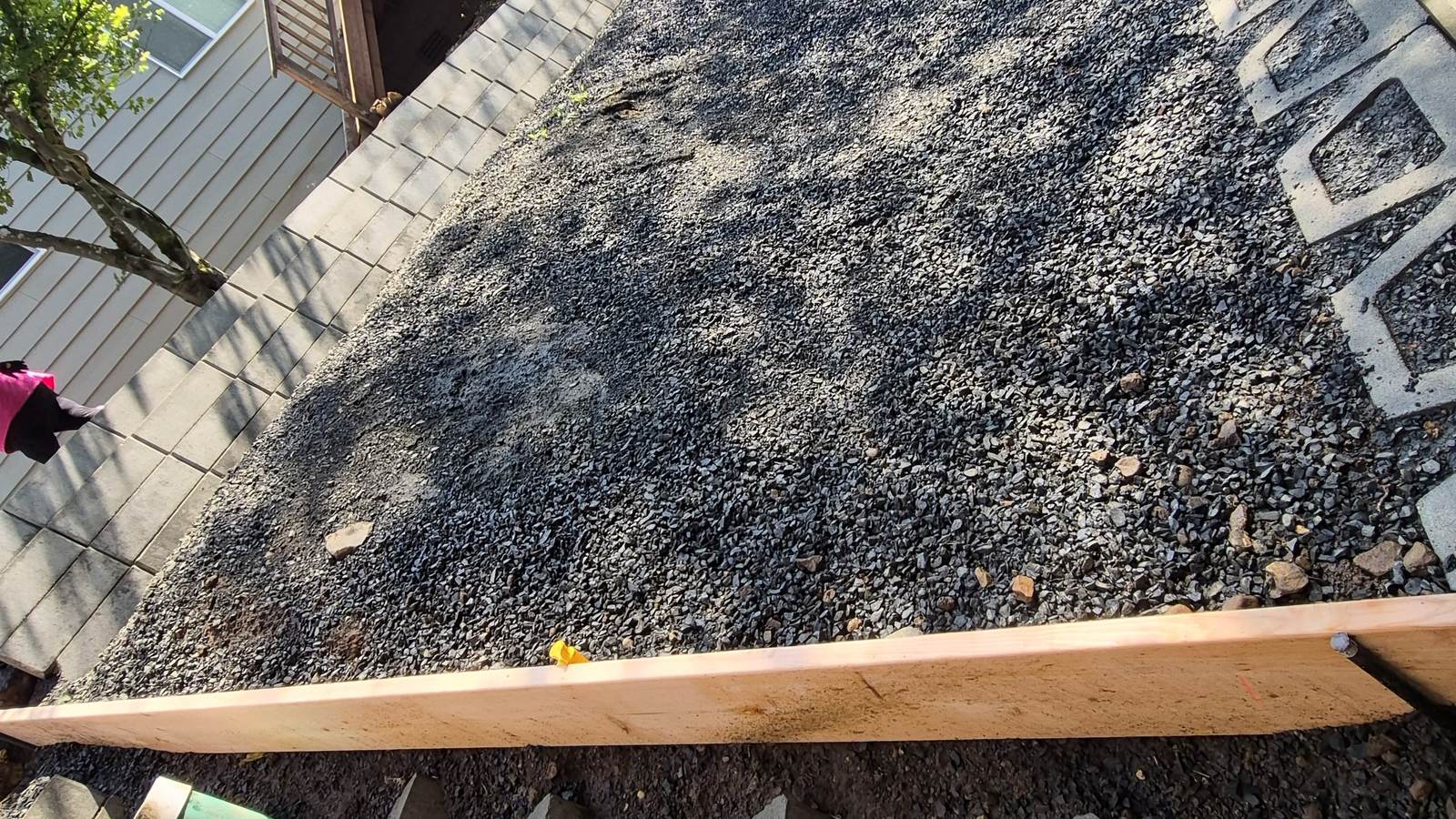
Along the fence line in the photo above, the ground was holding water against the posts and rotting them. The fix was a block edge on a compacted base, a trench and drain line behind it, and drain rock over the top. The posts stay dry, the water goes where it's supposed to, and the side yard is a gravel path instead of a bog.
If you've got a spot that never dries out, send us a photo or have us out to look. Goodfellas Landscape is at (360) 402-9183, and estimates are free across Thurston and Pierce counties.